
Personal Loan In 2026 :
Life doesn’t really have to wait until your bank savings have caught up with the amount of money you need at that time. There are many situations where the need for cash is immediate, such as when you have a medical emergency that requires immediate cash outlay, when there is some home renovation project which you simply cannot postpone, the possibility of a once-in-a-lifetime travel experience, or even when you want to consolidate debts.
Personal loans are designed to provide fast, unsecured credit facility, that can get the money deposited into your account with almost minimal document processing.The most common retail credit product in India is the Personal loan. Many borrowers sign up for this type of credit because it is easy to obtain and requires little paperwork; therefore, personal loans tend to carry higher interest rates than do home loans or gold loans (secured loans), which require some type of collateral.
I would suggest that you understand how personal loan works before you apply for one since an understanding will allow you to reduce the interest you pay on the loan during its term.This guide will provide you all the information about personal loans in India; eligibility, documents, interest rate, different types of personal loans, repayment terms, factors influencing approval or rejection and tips on how to get the best deal of getting approved for one.
What Does A Personal Loan Mean?
A personal loan is a type of loan offered by banks or non- banking financial companies (NBFCs) and digital lending institutes, to individuals for their personal use. A personal loan is an unsecured loan, meaning you do not have to give any asset to the lenders as a guarantee of repayment. The lender approves the loan based on your creditworthiness, income stability and repayment history. Since lenders carry more risk by lending money to you without any collateral, they charge higher interest rates compared to the secured loans.
Hence your credit score will be given a lot of importance while determining whether you will be approved or not for the personal loan.Personal loans typically have flexible end-use, meaning you can use them for nearly any purpose, like medical bills, weddings, home improvement projects, vacations, tuition costs, or to combine higher interest debts into one, easier-to-manage monthly payment.
How do Personal Loans Work?
The process is simple: You send in an application online, at a physical location (bank, NBFC or digital lender) or both; The lender will review your credit score along with income, type of employment, existing debts and other qualifying factors.If you meet the approval criteria, lenders will provide loan options based on your profile, which includes the amount of money you borrow (loan amount), interest rate and term of repayment (tenure).
Once you are approved, you will receive the funds directly, which usually gets to your bank account in 24 to 48 hours in the case of the pre-approved customer, while it can take a few business days for the regular customers. You will be making monthly EMI payments according to the duration of the tenure. When you have paid off all of your EMIs, your loan will be completed and your credit report will be updated to reflect your repayment.
Eligibility Criteria for a Personal Loan
As there is no collateral involved in personal loans, lenders depend on your financial history to assess your ability to pay back the loan amount. Some of the most common eligibility criteria used by most lenders are:
Age: 21-60 or 21-65, depending on the lender; some online lenders may also approve loans for applicants up to age 65.
Type of Employment: The are different types of employment, such as salaried employees at well-known companies, self-employed professionals, and business owners. Each of these categories has a different income threshhold.Regarding your income, salaried applicants must earn at least ₹ 15,000–₹ 25,000 net monthly depending on the city or lender. NBFCs and digital lenders may have a lower requirement. Regarding work experience, you must generally have at least 1–2 years of total work experience as a salaried employee and at least 6 months–1 year of employment with your current employer.
Credit Score: A lender’s ability to grant approval for a loan depends largely on your credit score, with most of them requiring at least 700 CIBIL score. The higher your credit score will be above 700 (i.e., over 750), the greater your chance of receiving the most advantageous rates and an even larger amount to borrow. 랜 Lenders also take into account the Fixed Obligation of Income Ratio (FOIR), the total of all current monthly loan payments (EMIs) and the proposed payment for the new loan must not exceed 40-50% of your monthly income.
Documents Required for a Personal Loan
The Loan Application Process Information gathered about an individual’s employment and financial situation will be accompanied by documents to verify either their identity and address, their past and current earnings, or both.
The general list of required documents for salaried applicants includes:
- For Salaried Applicants Aadhaar Card/PAN Card/Passport/Voter ID (proof of identity)
2. Aadhaar Card/utility bill/ration card (proof of address)
3. Three most recent pay stubs Last six months of bank statements
4. Latest Form 16 or IT Returns ID card/appointment letter (in some cases)
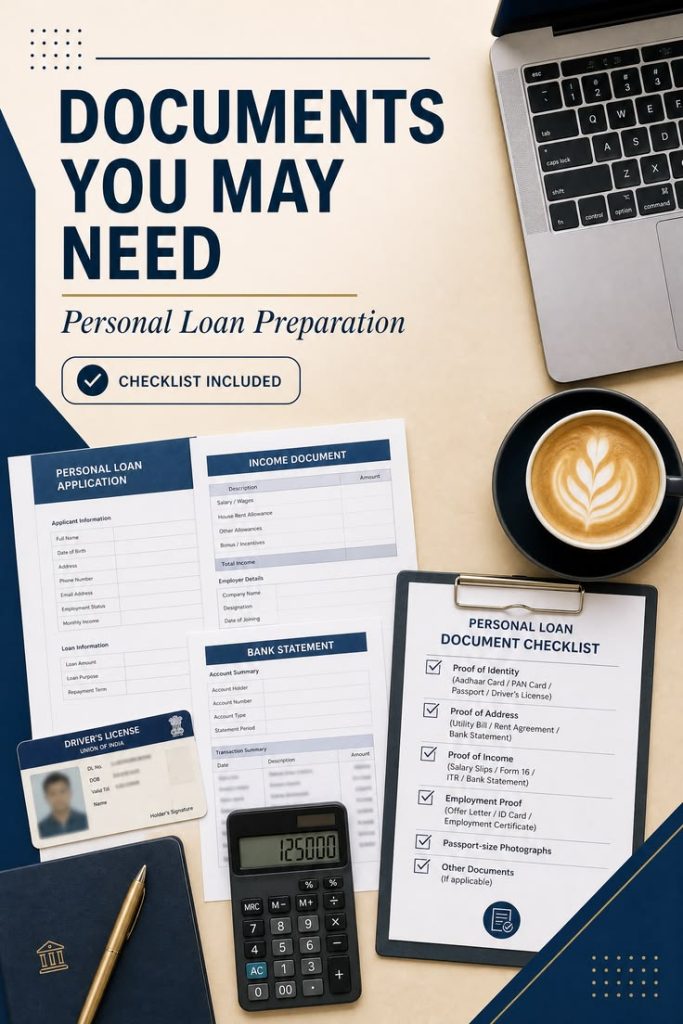
For self-employed applicants, a lender may request that you provide the following documentation as part of your loan application package:
- Legal Proof of Identity and Permanent Residence.
2. Tax returns for the previous two or three years along with a Statement of Income along with Financial Statements (audited) or Income Statements.
3. Recent bank statements from the past 6-12 months.
4. Certificates of business registration or a GST certificate (if applicable).
5. Some banks, particularly online NBFCs, can approve loan applications using just your Aadhaar e-KYC, PAN and basic proof of your income, without much paperwork.
Types of Personal Loans available in India
There are multiple options available for borrowing money, and therefore, lenders often create products that are designed for specific situations (purposes).
Standard/General Personal Loans:
This is the most common type of personal loan. It has fixed monthly payments (EMI) and a specified tenure. Moreover, it is available for any use of funds.
Medical loan:
Provides money you can use to purchase healthcare-related items and services; they may come from a hospital partner or lender and have lower interest rates than regular loans and will often be disbursed faster than other types of loans.
Wedding loan:
Typically used for weddings or other similar type occasions and typically have larger amounts of money available for borrowing. The terms are often more flexible than most other types of consumer loans as well.
Travel loan:
For trips (domestic or international), and may sometimes include travel insurance.
Home renovation loan:
Used to renovate or repair your home that you already own, but different than a home loan.Debt consolidation loan: specifically obtained to pay off multiple high-interest debts, decreasing your overall monthly payments and combining all payments into a single payment.
Pre-approved or Instant Personal Loan:
This loan is given to users who patronize a particular bank and have a good record of repayment. The loan has an almost instant payout, requires very little paperwork as the bank already has information about the user.
Everything to Know about interest Rates on Personal Loans
The interest rates on personal loans in India change a lot based on the type of lender (banks/NBFCs vs. digital lenders), your profile and the size of the loan. Banks and large NBFCs can offer lower rates, but digital lenders usually have a higher rate but also have faster approvals with less stringent eligibility requirements.The rate you will receive is determined by a number of variables: Your credit score. Normally, a higher CIBIL (credit) score will get you a lower interest rate.
The type of employer you have. Large corporate employers, government employees (PSUs), multi-national companies (MNCs) will typically receive better rates than someone working at a small company or a company that has not been around very long.
Income amount and stability: Higher levels of income often equate to lower risk for lenders.
Loan tenure and loan amount: Loan applications with smaller loan amounts are typically approved for lower rates when the tenure is shorter; large loan amounts are reviewed based on availability of income and fixed expenses of borrower.Existing customers (eg. holders of a salary account, savings account, loan account in good standing with the lender for a long period) may likely obtain preferential rates. Since rates vary greatly between lenders, the time is well spent checking at least two or three offers before making your selection. For three or five period of loan, a 1 to 2 per cent annual rate difference may total a significant ammount of money.
Repayment Options With The Length of Repayment Loan
The majority of personal loans are repaid via fixed EMIs (equated monthly installments) that includes both the principal amount and interest in an organized way. Loan terms generally vary between 12 months and 60 months, although some lenders provide longer repayment periods of up to 84 months for larger loan amounts.
Many lenders also allow Part-payment.
Part-prepayment : This means that you can make extra payments in addition to your standard EMI, which will reduce your remaining balance and shorten the overall length of your loan, or possibly lower your future EMIs.
Foreclosure: Paying all loan dues in full before the scheduled end of the loan period. Most lenders charge foreclosure fees (usually 2–5% of the remaining loan balance); however, some lenders waive them after a specified number of EMIs have been paid. If you expect to receive a lump sum during your loan tenure (as a bonus or through a property sale, for example) then verifying the foreclosure terms at the onset of the loan will allow you to plan the prepayment of your loan effectively.
How Credit Score Impacts Personal Loan
In assessing a Personal Loan application your CIBIL Score forms a very significant basis for loan approval.
Most lenders use the following criteria to start their evaluation process:
750 Plus: Excellent, most likely you will be approved quickly with a large loan amount at the lowest rates available.
700 -749: Good, good chance of approval but possibly at slightly higher rate than the best-case borrowers.
650-699: Fair, with a somewhat uncertain approval chance but higher rates. <650: Difficult, where most commercial banks will likely reject your application but some NBFCs and digital lenders would still consider your application but at much higher interest rates.If your score isn’t as high as you would like it to be, then taking a little time (e.g., few months) before you apply just to improve your score will be beneficial.
The first step to improve your score will be clearing all your outstanding dues. The next step would be reducing your credit card utilization rate. The final thing to consider is not to apply for multiple credit products at a time because every hard inquiry will slightly decrease your credit score.
A few benefits to taking out a personal loan:
No collateral necessary — you do not have to put up any physical assets Quick disbursement — especially with pre-approval and/ or digital applications Flexible spending — there are no limitations on what you can spend the money onFixed EMI program creates a steady budget.Reducing your total debt (credit cards, informal loans, etc.) into one low monthly payment is another advantage. A properly paid EMI loan will help improve your credit rating by mixing the types of credit that you carry as well as the manner in which you pay them back.
Risks and Considerations :
A higher interest rate than a traditional loan due to the absence of either security or cosigners. Make sure to calculate the total interest cost before agreeing to the terms and to be sure the monthly payment will be affordable considering the rest of your budget.
Debt Trap Risk – Risk of getting caught in debt traps due to easy loan access. So, make sure you borrow the minimum amount of money required and that you can afford the repayments.
Processing Charges – Most personal loans will have a processing charge of about 1% to 3% of the loan amount, too. Some are deducted outright from the disbursal; this needs to be calculated as part of your total cost of the loan.
Credit Score Impact – Lastly, applying for many loans in a short span of time, there will be many hard pulls on your credit report, which are going to lower your credit score. I’m not just saying apply for loans at random; apply for them for a reason.If you intend to repay your Personal Loan in full prior to the end of your tenure, you must check out the Foreclosure Charges by going through the foreclosure clause before you choose a lender.
Procedure of Personal Loan Application The majority of traditional banks and NBFCs have developed entirely online application systems. All that is required from borrowers through such systems is to complete their online application processes by entering their personal details along with their documentation requirements (proof of identity, proof of address, proof of income, etc.). Once these documents have been submitted online and verified via e-KYC systems, the banks will provide decisions on pre-approved applications almost almost instantly!
In-Person Branch Application: This approach is best if you want to be able to talk face-to-face with a banker, have unique or complicated income, or are looking for a big loan, so a banker can help guide you through the process.
Borrowing from online loan aggregators: These sites can show you loan options from multiple lenders at once, this will help you compare them and save your time, but you should be careful of sites that share your personal information to multiple lenders as this could cause multiple credit checks (hard pulls), which can affect your credit score.
Steps to follow for the best Personal Loan
Before applying, make sure your CIBIL Score is correct and remove any errors that may be present. Compare at least two or three lenders to get an idea of interest rates, processing fees and foreclosure charges If you have a salary account with a bank, consider applying to this bank. There is a strong possibility that you will receive the lowest interest rates due to your existing relationship with the bank.

Pick the shortest time frame you can repay comfortably; with a shorter time frame, you pay less interest overall Carefully review all of the prepayment and foreclosure clauses before you commit yourself, especially if you expect that your income will increase while your loan is outstanding. Do not take a larger loan than what you need simply because your lender offers you a greater amount.
Common questions:
How much can I borrow as a personal loan?
The loan limits vary significantly depending on the lender and applicant’s profile; generally the majority of banks provide Personal Loan upto Rs 40-50 lakhs for well qualified applicants; whereas some of the NBFCs and digital lenders restrict the amount to a lower value.
What are my chances of obtaining a Personal Loan with Low Credit score?
Yes, there are a few companies, especially some NBFCs & Digital Lenders who may lend to individuals with low credit score but at very high interest rates and possibly very strict terms of repayment. Therefore it would be better to build your credit score and then apply for a Personal Loan because it would save you a lot of money in the long term because your Interest rates will be pretty low and your chances of getting approved will be extremely high.
Is there any restriction on getting two personal loans at a time?
In practice, yes, because of FOIR (Fixed Obligations to Income Ratio). All of your current monthly obligations, including the new loan, must remain within a lender-approved percentage of your income. Also, multiple types of active loans will be a red flag to most lenders.
Do personal loans qualify as a tax deduction for the interest?
Interest on personal loans is usually not deductible from your taxes. If you use your personal loan for other reasons, like improving your home or starting a business, you may find some of the interest is deductible in some situations. To determine whether it applies to you, contact a tax professional.
What occurs if I fail to make the regular monthly payment?
Failing to make one of your monthly payments typically results in a late payment fee being applied to your account, and the late payment will also be reported to the credit agencies which will lower your credit score. Most creditors have a little bit of time (a grace period) before they charge you any fees for missing a payment; if you see that you may miss a payment, you should immediately contact your lender because they might be able to assist you in some way with restructuring the loan.
Conclusion :
In India, personal loans are the most flexible form of borrowing available to consumers. When you use a personal loan properly, you can meet a temporary need for money without creating a new problem in your finances in the long term. To make sure that a personal loan will help you rather than hurt you, you should try to borrow only what you really need, compare personal loan offers from different lenders and try to find one with a repayment period that is not so long that it really hurts your monthly budget.
Managed well, a personal loan will improve your credit rating and make it easier and less expensive to obtain the next loan or credit card you apply for.Explained in general sense, the interest rates, processing fees and regulatory guidelines referenced in this article may not be up-to-date or accurate either. Before proceeding to apply for a loan, always contact your lender to verify these terms are still current.
Leave a Reply