Gold Loan In 2026 :
Gold is more valuable than value that is sentimental in Indian homes because of the protection it provides against unforseen financial burdens that is, when families require immediate access to cash in times of urgency, the value of gold is business capital. A gold loan is a loan against jewellery, coins or bars of gold that is secured until the time it is paid back which makes this type of loan expeditious, easy and affordable than most forms of growing credit.

The guide goes over everything you need to kno about gold loans in India -how they work, who qualifies, what paperwork you must have to apply, how lenders set interest rates and loan to value ratios, what you must pay back and your different payment options, and important information on obtaining the best deal possible on a Gold Loan.
Explanation of what is a Gold Loan :
A gold loan is a kind of secured loan in which you use your gold ornaments, coins or bars as security with a bank or financiar institution which can be either an NBFC (Non-Banking Financial Company) or any other lender which is regulated by RBI to avail the loan amount.
The lender will assess the purity of your gold and weigh it to determine its present market value, after which they will disburse an amount of loan based on a percentage of that value, which is called the Loan to Value (LTV) ratio.In a gold loan situation, since the lender is physically holding the asset in their vault as collateral, so the loan is considered to be very low risk for them.

In turn, this often means that a borrower can expect to have their loan approved in a timely manner along with limited documentation requirements and a lower interest rate (in general) compared to other types of unsecured loans (i.e., credit card or personal loan).
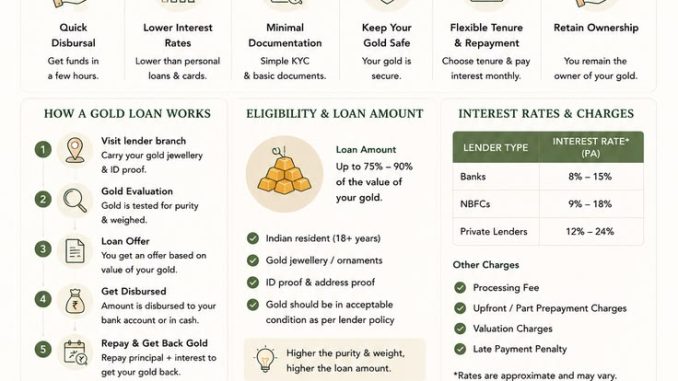
How Do Gold Loans Actually Work?
A gold loan is generally a simple process, with the following steps:
1: The borrower applies in person at a bank or NBFC or submits an online application and books an appointment for a Gold Evaluation.
2 : The gold purity (Karat) and weight of your gold is assessed by an in-house appraiser who is certified. The value of your gold, as well as its purity and weight, are used by the lender to determine its current market value.
3 : Based on the market value of your gold, the lender will provide you with a loan amount based on a percentage set by RBI’s LTV. If you agree to the terms, your gold is securely held at a vault of the lending institution and funds are released typically within hours.You repay via EMIs, a bullet payment, or any other repayment scheme of your choosing.
4 : once your facility is completely terminated, your gold is returned.
Eligibility Conditions for a Gold Loan
There are very few eligibility criteria for gold loan applications compared to other loans, mostly because the loan is collateral based, and the lender is looking at collateral, not your income details to determine if you qualify for the loan.
Mostly 18–21 years and up, with many lenders having no set maximum age requirement.

A resident of India with proper KYC documentation.18 – 22 karat gold jewellery coins or bars. Many lenders do not require proof of income unless providing a larger loan amount.
A gold loan offers an opportunity for people who would otherwise find it difficult to get unsecured loans through regular sources, especially those who do not have a regular income (e.g. housewives, students and small businesses).
Documens Required For A Gold Loan:
Identity proof (can be Aadhar Card/PAN Card/ Voter ID/ Passport)
Address Proof (can be Aadhar Card/ Utility Bill & Ration Card)
Recent passport-size photographs.
Most lenders do not require a proof of ownership of the gold collateral because of the fact that it will be assessed by the lender during the gold appraisal process.
Self declaration of gold source (for larger loan amounts as per Anti-Money Laundering regulations)
Gold Loan Interest Rates:
Factors That Influence Interest Rates for Gold Loans : The interest charged on gold loan depends on the lender, the amount borrowed, the loan term and the mode of payment. Generally, gold loan interest is lower than personal loans or credit cards because the lender’s risk is greatly reduced by the collateral.
Banks generally provide lower rates compared to NBFCs but if you choose a lender like Muthoot Finance or Manappuram Finance, then loan processing time is much quicker and loan-to-value ratio flexibility and doorstep facility is available.

Because the rates are variable based on RBI’s repo rate and the overall market conditions, it is recommended that you compare the loan offerings of two or three current lending institutions (banks and NBFCs) before you select a lender to provide your loan rather than using previously advertised rates. Many lenders also offer a slight reduction in interest rates for loans with shorter terms as well as for existing customers.
Loan to Value (LTV) Ratios Explained
The LTV Ratio indicates the portion of your gold’s assessed value that you can borrow against. The Reserve Bank sets the LTV Ratio and periodically reviews and adjusts it. Therefore, you should verify the LTV Ratio with your lender or check the Reserve Bank’s current guidelines before applying for a loan. Generally, the closer you are to the maximum allowable LTV, the greater the risk being taken by your lending institution and therefore, you can expect to pay a higher interest rate.
Varieties of Gold Loans you can repay in Full Payment PlanAll lenders provide more than one repayment option, you choose based on your cash flow situation
Types Of Gold Loan Repayment Schemes:
EMI Option: With this repayment option, you pay fixed monthly payments of principal and interest combined on a regular loan. This repayment plan allows for the most simple monthly budget planning purposes.
The Bullet Repayment method : It requires full payment of the Principal plus accrued interest, all at once, in a single payment at the end of the Loan Tenor. The bullet repayment method is ideal for borrowers who are expecting a large lump-sum payment from other sources in the future (a business receivable), and you’re not going to have an ongoing out-of-pocket expense to cover a loan and its interest every month.

Overdraft Facility: The overdraft loan/line of credit allows you to have an approved credit limit by pledging your gold as collateral, and then draw as much as you want, when you want, with interest paid only on what you actually borrow from the account. It is the best method for borrowers who experience irregular and/or difficult to predict cash needs.
Partial Payment Scheme: You can choose a partial payment plan. This means you pay interest now and then pay back the main amount later.
Advantages of Gold Loans :
Quick processing – most lenders give you money within hours of your gold being evaluated.
• They will have lower interest than an unsecured loan of any kind. • Most require very little documentation and most have no income proof requirements.
• Lenders offer various repayment options based on your cash flow.
• Most lenders have virtually no condition on the use of the loan proceeds for any purpose such as medical, education, business, travel, etc.
• Your Gold will be securely stored by lender and mainly insured during the tenure of the loan.
Some Risks and Issues to Consider
The risk of losing gold: In the event that you default on your repayment, the lender has the right to sell your pledged gold via auction to recoup the amount owed. Not only are you risking your credit score, but too, there is a possibility that your jewellery may hold sentimental value and you will lose it permanently.
Fluctuations in the price of gold : In the circumstance that gold prices decline significantly during the period of your loan, some lenders may require you to either pay back the difference or provide additional gold as collateral to maintain the agreed-upon LTV (Loan-to-Value) ratio.
Charges That Are Not Explicitly Stated in the Contract: Be sure to thoroughly evaluate the processing charges, appraisal charges, and prepayment penalties that may accompany your loan agreement because they could greatly impact the overall cost of your loan.
Outstanding Accrued Interest: One of the challenges with a bullet repayment structure is that interest is not paid on a regular basis, but instead is accumulated throughout the duration of the loan and must all be paid off upon the final closure of the loan.
The Gold Loan Application Instruction guide :
Offline: Take your gold to the bank or non-bank lender you want to use and bring your KYC documentation. The gold will be appraised right when you bring it in, and after you agree to the offer, you’ll be able to get your money immediately or the same day.
Online: lenders have now developed a blended process, where you can apply for a loan using the Internet, then receive an initial assessment of the value of the gold, and then arrange to have the gold collected from your home or schedule a visit to the branch for the final assessment.

Some lenders provide customers with the opportunity to apply for a top up loan or renew an existing loan using a completely digital process, without having to visit the branch again. Either option requires you to compare the various loan offers provided by at least 2-3 lenders. The interest rate, LTV ratio, processing fee, and repayment flexibility can vary between the different lenders.
Gold Loans Vs Personal Loans:
A quick comparison for anyone considering instant financing options: Gold loans are always secured, which means you have to pledge something (the gold) as security.
A personal loan is typically unsecured, so you don’t have to pledge anything (i.e., no security). With gold loans, because you’re providing the lender with something as security (the gold), they typically charge you a slightly lower interest rate.
Gold loans are usually processed faster (same day) than personal loans. Personal loans have no physical instrument at risk, but generally require a very strong income and credit profile for approval.
Gold loans come in handy for any immediate need, whether short or medium term, while personal loans come in handy because it allows borrowers a longer period of original loan tenure for which to pay back. If you have idle gold lying around, and require funds immediately, without undergoing a lot of credit checks, then gold loans would most likely be the more cost effective alternative to personal loans.
Find the best gold loans :
Compare the LTV ratio as well as the interest rate with at least two or three other lenders, both bank and nonbank.
Make sure you know about all charges beforehand: processing fee, valuation or assessment fee, foreclosure or prepayment fee, and late payment penalty.
Choose a repayment scheme that suits your cash flow rather than chasing after the lowest advertised rate. Be aware of the tenure of your loan and the renewal dates to avoid accidentally defaulting and risking of auction.Please verify if the financial institution is offering a safety plan for your gold, that you have used as a pledge for your loan.
FAQs :
Do you provide a gold loan for low purity gold?
Most of the lending institutions accept gold with at least 18 carat purity. Some institutions may not accept gold that is below 18 carat purity. If they do, the value of the gold will be much lower.
If I’m unable to pay back my gold loan, what will the lender do?
The lender will usually send reminder notices and will provide a grace period before initiating the auction process, as per the agreement signed.Can I pay All Off or payoff my Gold Loan in Advance? Yes, most lenders allow you to close out your loan before it matures. Some lenders charge a small fee or penalty for prepayment or full payment.
How do I determine the value of gold I am borrowing against?
Lenders test the purity of gold (karat) and also the net weight of gold (excluding any stones or non-gold attachments) through standard testing methods. Based on this, lenders determine the value of your gold based on the current market price of gold.
Is the interest on a gold loan tax deduction?
How you use your loan funds (for business versus personal/home use) will also affect whether or not you can deduct certain expenses in some situations. You will want to verify this with your tax professional or accountant based on your specific circumstances.
Conclusion :
A gold-based loan can provide an easy way to access fast cash in India without having to liquidate a valued item. Before committing to a credit transaction, look at it carefully. Find a lender that gives you the best rate, and compare the total cost of the loan, which includes limited EMIs and the total rate charged. One should not take a loan that is greater than what one can repay because the gold collateral will be offered for security.
Therefore, when the individual has the right lender and the suitable loan structure for them, gold loan becomes an appropriate means of bridging the gap financially and also brings the gold back to the rightful owner.The interest rates, LTV limits, and regulatory standards described above are in a general nature, and are subject to change. Prior to publishing specific numbers, you should check with your lender or the RBI for updated rates and regulations.
Leave a Reply